
Benjamin Gucciardi was born and raised in San Francisco, California. His first book, West Portal (University of Utah Press, 2021), was selected by Gabrielle Calvocoressi for the Agha Shahid Ali Prize in Poetry and was named a finalist for the Northern California Book Award and the Julie Suk Award. He is also the author of the chapbooks Timeless Tips for Simple Sabotage (Quarterly West, 2021), chosen by Elena Passarello as the winner of the 2020 Quarterly West Chapbook contest, and I Ask My Sister’s Ghost (DIAGRAM/New Michigan Press, 2020).
Randall Mann
Randall Mann is the author of Complaint in the Garden (2004), which won the Kenyon Review Prize in Poetry; Breakfast with Thom Gunn (2009), finalist for the Lambda Literary Award for Gay Poetry and the California Book Award; Straight Razor (2013), finalist for the Lambda Literary Award; Proprietary (2017) a finalist for the Northern California Book Award and Lambda Literary Award; A Better Life (2021); and Deal: New and Selected Poems (2023). He is also the author of a book of criticism, The Illusion of Intimacy: On Poetry (2019), as well as co-author of the textbook Writing Poems (2007).
Neal Tayco

Neal Tayco is a second-year MFA in Writing grad student at the University of San Francisco, where he is the associate poetry editor for the program’s student-run literary journal, Invisible City. Originally from Subic Bay, he is currently based in the Bay Area where he also works as a Filipino translator/proofreader for the County of San Mateo. Neal can be found online at @nealtayco on both Twitter and Instagram, where he habitually overshares aspects of his life with internet strangers. Neal’s writing can also be found published in The San Franciscan.
Poem on Belonging
IN OLONGAPO CITY
the Apo’s head is statued on the rotunda,
 		his eyes toward here,
 	his repaved homeland—
Home is a place named after this
 	beheading. I do not know my ancestors.
 	They have always been watching
me. Home was the largest overseas
 	US military installation.
 	There, we learned to worship
above the waters of warship wreckages,
all the American frigates
 	we could not repair.
 	We fucked the sailors,
and we mended their broken ships.
Under our care, what we could salvage
 	we took to open auction—and when the wars
finally ended, the rest we turned into museums
 	commemorating a victory against
 ourselves. We were rich off the offal,
 	so we bought our own exit
wounds: I cannot now write about home without
the visa.
I, too, cannot be a whole body:
 	doomed to survey those prior worlds,
 		these chief parts of mine, stuck seeking
my childhood home. In California,
weather is the kind of warmth we have
no language for. I have never lived far from the sea,
 	a bad pursuit this body
 	          refuses to break.
Copyright © 2022 by Neal Tayco. Used with permission of the author.
Jane Kuo

Jane Kuo is a Chinese and Taiwanese American writer who grew up in Los Angeles. She is an author, a nurse, and a nurse practitioner. Jane graduated with a degree in English Literature from UC Berkeley, where she studied under Bharati Mukherjee, Ishmael Reed, and Robert Hass. Also, she once borrowed a pencil from Maxine Hong Kingston.
Jane lives in California with her husband and two kids. Her first novel, In the Beautiful Country, is inspired by the events of her childhood.
Ayodele Nzinga
Ayodele Nzinga is the founding producing director of the Lower Bottom Playaz, Inc., Oakland’s oldest North American Theater Company. Nzinga is a multi-disciplined creative force; a brilliant actress, producing director, playwright, poet, dramaturg, performance consultant, educator, and community advocate. She is the founder of Lower Bottom Playaz Summer Theater Day Camp, established in 2007, a performance-based Literacy through the Arts day camp that provides enrichment activity for youth 5-18.
She is the founding Director of the Black Arts Movement Business District Community Development Corporation, Oakland, (BAMBD CDC); and founding producer of BAMBDFEST an annual international month-long arts and cultural festival celebrating and hosted by the Black Arts Movement and Business District in Oakland CA.
Nzinga holds an MFA in Writing and Consciousness; a Ph.D. in Transformative Education & Change; is a Cal-Shakes Artist Investigator Alumni; a Helen Crocker Russell Arts Leadership Fellow; a member of the Alameda County Women’s Hall of Fame; recognized by Theater Bay Area as one of the 40 faces in the Bay Area that changed the face of theater in the Bay Area; is recognized by the August Wilson House as the only director in the world to direct the complete August Wilson Century Cycle in chronological order. Nzinga’s work for the stage has been reviewed internationally.
Tshaka Campbell

Tshaka Campbell began writing poetry long before performing it in an attempt to find his own voice and point of view within the art form. As a performer, he is recognized as an accomplished artist internationally and performance accolades include not only being a member of the Nuyorican national poetry slam team and the Da Poetry Lounge (DPL) slam team, but also earning the Grand Champion title in San Francisco and Hollywood. In 2010, he was also honored with the UK Unsigned Artist award in poetry.
Tshaka has toured a number of US cities and across the globe, featuring at venues such as the legendary Apollo Theatre and the O2 in London England.
He continues to be inspired by the struggle of life, the uncertain certainty of the universe and what it chooses to hand you. His wife and daughter show him the way daily, as well as so many authors and poets such as Octavia Butler, Ben Okri, Rumi, Baldwin, and countless others who spin language like silk.
He currently resides in San Jose where he serves as Santa Clara County Poet Laureate and continues to ask the world to listen different.
K.R. Morrison
K.R. Morrison is a San Francisco based poet, drummer, and high school teacher who has been teaching English and Creative Writing for 18 years. Her first chapbook Cauldrons was recently published by Paper Press Books, within which “Her Altar” received a Pushcart nomination. Apart from reading at curations in New Orleans, Los Angeles, and New York, Morrison has featured throughout several Bay Area readings. Her work can be found in Switchback, Quiet Lightning, Haight Ashbury Literary Journal, Gasconade Review, Great Weather for Media, Spartan Press, the Lake County Bloom, and the Cooch Behar Anthology.

Morrison featured on two popular Bay Area’s podcasts, Bitchtalk and Storied: San Francisco about being an educator, musician, and writer in a city that’s rapidly changing. Most recently, Morrison’s poetry was featured with NPR affiliate, “KALW’s New Arrivals” with Lisa Morehouse, the “Social Yet Distanced” podcast, the “Rooted in Poetry” podcast, and the Haight Ashbury Literary Journal’s poetry podcast.

On Facebook: K.R. Morrison
On Instagram: @krmorrisonpoet
Poems on Belonging
CHARLOTTE ANN

today I walk barefoot for you
I harbor homemade tortillas
in my heart I never
did taste, I bleed out
this world loaded with a .38

like mother—like daughter
I never know
what waterbeds or polluted men
need a lesson
from a drifting bullet

today I tell your stories

who knows what’s true
from the fiction your scars harbor
for a fallen woman’s final justice

the poet in me thinks that just like you
make-believe and memory
can make a homemade meal in 20 minutes

to feed double shift mothers
to nourish street sons, bruised daughters
your ever evicted stove
of legacies dancing
in lard laden frying pans

today I walk barefoot
and the souls of my feet bleed
so I walk stronger, I smile
remembering a little girl you enlisted
to rub your pirate black feet

I walk barefoot on the bones of your words—

you’re good, Babygirl. But your sister,
she has those softball hands.
She can rub some feet.

so I worked harder
on your soles harboring whiskied men, fists
and marbled in the madness, so much
broken glass mixed with moonstone
so much soul and sadness

Funny what a mother can do.
She can return to smiles
set the tone, salvage
love inside knee scabs
while she loses raising you


HER BURDEN

In one week, a woman
            can grow life
                         shoot a rapist		bleed out

             the last word
                          while he leaks red hell

                          on car fenders 	        she waxes
                          when she isn't waning


In one week, a woman
    can talk tears off suicidal bridges
                while she bridges

                words to new days
                dressed in smiles	                preparing

                breakfast mixed with messages
                self discovery over easy
                pancakes that make pain too, pass


In one week, a woman can become
                an armed robber 		        or she can

                nurse bottles and beers
                (and in the same week)
                bring freedom to kids	        she never raised
				                                but carries

While vacuuming others’ mess, a woman
                can write a poem

                on hallways she architects
                inside her head
                                                                              that always        she revises
	                                     surveillances

She can burn
               down the world
                          with flammable honesty

                          then discover fire
                          extinguishers

                          while men
                          cough, choke, drop
                          for cover
Copyright © 2022 by K.R. Morrison. Used with permission of the author.
Dear Poet

New York, NY (January 27, 2022)— The Academy of American Poets, the originator of National Poetry Month—now a worldwide celebration—invites students in grades five through twelve to participate in Dear Poet 2022, an annual multimedia education project featuring videos of award-winning poets reading their work, including poets who serve on the Academy of American Poets Board of Chancellors and who have received Academy of American Poets Laureate Fellowships. Students are encouraged to watch the 26 newly-released Dear Poet videos, write letters in response to the poems, and submit their letters during National Poetry Month this April. Selected letters will be published on Poets.org, one of the most visited sites for poetry on the web, and shared on social media. Each year, the Dear Poet videos are viewed by tens of thousands of students across the country and more than 3,600 students from 35 states participate by sending in letters.
The 26 award-winning poets participating in Dear Poet this year include Academy of American Poets Chancellors Ellen Bass, Marilyn Chin, Kwame Dawes, Forrest Gander, Marie Howe, Dorianne Laux, David St. John, as well as Academy of American Poets Laureate Fellows Marcus Amaker, Semaj Brown, Aileen Cassinetto, Leslie Contreras Schwartz, Magdalena Gómez, Georgina Marie Guardado, Chasity Gunn, Kari Gunter-Seymour, Luisa A. Igloria, Dasha Kelly Hamilton, Melissa Kwasny, Debra Marquart, Trapeta B. Mayson, Anis Mojgani, Chelsea Rathburn, Lloyd Schwartz, M. Bartley Seigel, M.L. Smoker, and Brian Sonia-Wallace.
“As many students process their lives in our complicated time, The Dear Poet project is a great opportunity for them to interact with contemporary poems and poets who are confronting the same issues through their writing. Dear Poet provides students with an opportunity to learn about some of the leading poets writing today, to read their poems and respond by writing letters to the poets. Selected students will even receive a personal response from their poet!” said Dr. Madeleine Fuchs Holzer, the Academy of American Poets Educator in Residence.
To learn more about Dear Poet 2022 and to participate in the project, visit: http://www.poets.org/dear-poet.
An accompanying lesson plan will be available on the Dear Poet 2022 page in mid-February.
For additional resources to assist with the project, visit the Dear Poet 2021 lesson plan; read an essay about Dear Poet; check out one high school’s past participation in the project; and browse this Dear Poet teacher collaboration featuring video walk-throughs, writing prompts, and a short assignment. For some examples of student letters, visit last year’s Dear Poet page.
About the Academy of American Poets
Founded in 1934, the Academy of American Poets is the nation’s leading champion of poets and poetry with supporters in all fifty states. The organization annually awards more funds to individual poets than any other organization through its prize program, giving a total of $1.25 million to more than 200 poets at various stages of their careers. The organization also produces Poets.org, the world’s largest publicly funded website for poets and poetry; organizes National Poetry Month; publishes the popular Poem-a-Day series and American Poets magazine; provides award-winning resources to K–12 educators, including the Teach This Poem series; hosts an annual series of poetry readings and special events; and coordinates a national Poetry Coalition working together to promote the value poets bring to our culture.
National Poetry Month 2022
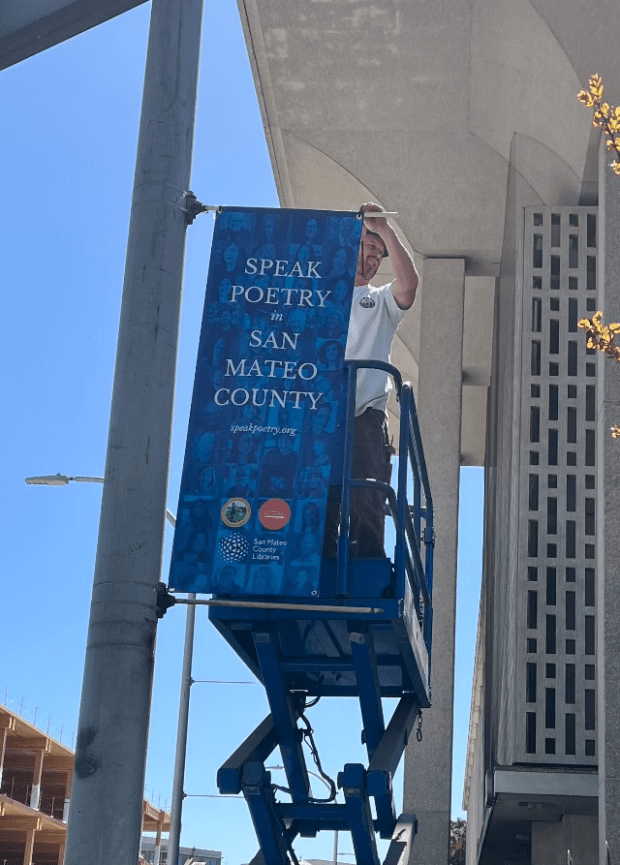
(San Mateo, Calif., April 1, 2022) It is National Poetry Month all over San Mateo County! The County of San Mateo and cities in the county are proclaiming April as National Poetry Month upon the request of San Mateo County Poet Laureate Aileen Cassinetto. Ms. Cassinetto is also spearheading several events to celebrate poetry and the work of poets in the county.
On April 1st, the “Speak Poetry in San Mateo County” banner was put up at the County Center in Redwood City, with support from the Offices of Supervisor Warren Slocum and Supervisor Carole Groom, the Office of Arts and Culture, and the county’s Public Works team. The Speak Poetry web archive was launched the same day featuring the bios, poems and civic engagements of over 70 poets from San Mateo County and the work of over 200 youth poets, as well as more than 70 poets from the greater Bay Area with ties to the county.
Following National Poetry Month proclamations by the County Supervisors and the mayors and councilmembers of the cities of Pacifica, Burlingame, San Mateo, Redwood City, Brisbane, Menlo Park, San Bruno, Belmont, Half Moon Bay, East Palo Alto, Daly City and the Midcoast Community Council, activities, readings and programs have been launched around the county celebrating local poets and the role of poetry in our communities, including a Makerspace Poetry Lab pilot project for all ages to promote STEAM and encourage various ways of looking at the world in terms of relationships and possibilities. Additionally, almost 200 trees have been planted in honor of San Mateo County’s poets and poetry advocates, individually and as a group, for their many ways of making and giving and paying it forward.
Launched by the Academy of American Poets in April 1996, National Poetry Month reminds the public that poets have an integral role to play in our culture and that poetry matters. Over the years, it has become the largest literary celebration in the world, with tens of millions of readers, students, K–12 teachers, librarians, booksellers, literary events curators, publishers, families, and, of course, poets, marking poetry’s important place in our lives.
#
Check out poetry events near you. Happy National Poetry Month!
Dear Earth, Dear Billie Eilish

Part cento, part sensory poem with lines from “all the good girls go to hell” by Billie Eilish, “Feels Like Summer” by Childish Gambino aka Donald Glover, and the UN Climate Report.
This collaborative poem was crafted during a workshop facilitated by San Mateo County Poet Laureate Aileen Cassinetto in partnership with Menlo Park Library, 14 April 2022, as part of the San Mateo County Youth Ecopoetry Project (2021-2022).
Dear Earth, Dear Billie Eilish
This is not fiction
but a litany of broken climate promises,
a yawning gap between climate pledges,
and reality
I'm hopin that this world will change
I hear silence
You can feel it in the streets
changes to our lifestyles
People care, and they’re engaged
I see lights
Birds were made for singing
I feel plastic
Slow Down
We are at a crossroads
I taste coffee
It feels like summer
I smell dust
Hills burn in California
It’s now or never
progress towards net zero
I make a wish
My turn to ignore ya
I hope for change
Don't say I didn't warn ya
I hear ya
 Speak Poetry in San Mateo County