Izzy de Souza

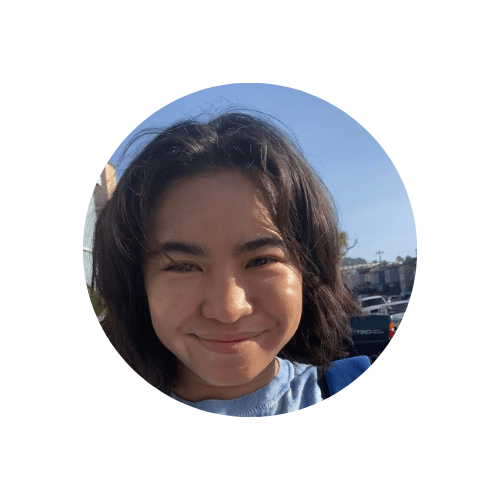
Izzy de Souza is in the 11th grade. She has been writing poetry for over 10 years. She enjoys the creative process and imagination needed to write poetry. Poetry provides a feeling of freedom and expression for Izzy. Outside of academics, she is a sprinter for her Varsity Track team and is a producer of the school media channel that showcases student life. Izzy is also proud to volunteer for the Mission Economic Development Agency (MEDA). “Rooted in San Francisco’s Mission District, MEDA is advancing a national equity movement by building Latino prosperity, community ownership and civic power.”

Poem on Belonging

VOYAGE

Embodiment of energy,
you remind me I am the shallow one.
The mortal fool at the mercy of your uncertainty.
I am humbled by your magnificence, 
yet you envy my journey.

Commanding like an emotion,
you announce your immortal message from below, 
and I travel over your fervent expression.

Briefly, I may gaze into your mystery. 
While you carry me with indefinite posture, 
I begin to understand.
I am not the one in control.

The impending feeling rises one final time, 
so I wonder about my true destination.
And as you reach down to me 
from far above my head, 
suddenly, I am small.

Copyright © 2022 Izzy de Souza. Used with permission of the author.

Iris Li

“My name is Iris Li and am a high school junior. I have been writing as a hobby since elementary school. I enjoy using my pieces to express my opinions on social issues. After participating in the Daly City Youth Poet Laureate for two years now, I look forward to taking part in writing for many other competitions. During my free time, besides creative writing, I enjoy playing the guitar and learning how to code!”

Ecopoem

CALIFORNIA

fire engulfed us.
its flames daring us
to touch its
yellow and orange stripped hands. it mocked at our distance
to come closer.
it laughed at our attempts
to wipe its existence.
and worst of all
it allied with the sky.

it pitied us
for a moment,
but it returned to 
dominating
our homes
our uncontrollable tears
and our powerless shouts of anger.

maybe the sky had reconsidered — 
as it fought with its “ally”. 
drops of hope fell from above. 
from tinkles of jingle bells,
to an entire full on symphony.

fire was hindered
by our hopes.
it began to diminish
by the hour.
but before its
painful death,
it roared up at the sky. 
expressing its long lashed anger. 
then it disappeared, 
leaving behind its
faintly evident trace
of its existence.

Copyright © 2022 Iris Li. Used with permission of the author.

Juleen Mallari

Juleen Mallari is in 8th grade, currently attending Fernando Rivera Intermediate School. She enjoys writing poetry because it’s a vessel to pour out her thoughts and emotions through beautifully sculpted words and rhymes. Like many forms of art, Juleen enjoys how poetry can connect and impact others. On top of writing poetry, she also loves to journal, play piano, sing, read, and bake. At school, she is a member of School Site Council and Student Government. Juleen also volunteers at Glad Tidings Church, teaching 3-5 year olds, being a part of the worship team, or even doing tech.

Poem on Belonging

A PAUSE

You never know it’s your last
Until it’s all gone
and you realize you were moving too fast
Our focus is always on what’s ahead,
so we often forget
to think about the “now” of the moment

No one could’ve imagined
that in the blink of an eye
The people you love, 
The places you cherish, 
And the feeling of freedom
could just be taken away

We lived lives going 100 miles an hour
Devoured by stress and exhaustion
So for over a year,
time just stopped…

It felt like everything ticked slower
a pace we learned to adapt to
We began to pay attention to what truly mattered, 
Hoping together for the better

But now we’re going back to our old ways
Accelerating and bracing for fast paced days
Yet we cannot forget the long days in our homes,
pondering the highs and lows of life
Sometimes a pause is all it takes

Copyright © 2022 Juleen Mallari. Used with permission of the author.

HMB High

Juan A., Jazmin F., Sara G., Deirdre J., Mikaela S., Aidan T., Isabel V., Dylan W. were coastside residents and attended Half Moon Bay High School.

Poem on Belonging

HALF MOON BAY HIGH POEM

I could not tell you what this poem means.
I like to think that I’m present, when there’s nobody there
Self is a construct I am rebuilding.

The grass held all the words she wished she could say
Her mind held a sun, a moon, stars.
I could not tell you what this poem means.

I tend to think I’m dandy, when I’m uneasy and scared 
I come to you with nothing yet you see past the fabrications
Self is a construct I am rebuilding.

The color of my skin, a prerequisite
People don’t understand they live in a candy coated world here
I could not tell you what this poem means.

Two halves of whole diminished by foe 
Sometimes I feel like nothing at all
Self is a construct I am rebuilding.

She’ll run through life as her own tour guide.
To wake for change, to sleep to start again tomorrow
I could not tell you what this poem means.
Self is a construct I am rebuilding.

Copyright © 2022. Used with permission of the authors.

Nia McAllister

Nia McAllister is a Bay Area born poet, writer, and environmental justice advocate working at the intersection of art, activism, and public engagement. As Public Programs Manager at the Museum of the African Diaspora, Nia creates participatory spaces for creative expression and literary dialogue. Nia’s writing has been featured on Poets of Color podcast and published in Radicle magazine, Meridians journal, and Painting the Streets: Oakland Uprising in the Time of Rebellion (Nomadic Press, 2022). Nia featured in the Hell/a Mexican reading hosted by the Redwood City Public Library in 2022.

Poem on Belonging

650

They name the streets after presidents around here 
          (the dead and not so dead).
They alphabetize them, rank them, and make entrance exam of our sidewalks. 
It helps us remember that our streets like our surnames
are somebody else's blood legacy.

I didn’t live on the other side of the tracks, 
but I lived on the other side of Jefferson. 
To some I just repeated myself.

I didn’t live on the other side of the tracks,
I lived on the other side of Jefferson.
A surveilled intersection, a crosswalk waiting to claim another school child. My mother gripped my hand tightly at every opportunity.
She knew Clinton was too busy to ever see us coming.

There was never any place to park on Adams Street.
And our neighbor kept his three jeeps, his boat, and his nephews’ fleet 
in the red zone he painted for himself.

My mother still writes chalk messages
along the pavement telling them
two cars can fit in the space in front of our house. 
She is proud of her curbside protest:
A reminder that we’re not going anywhere.

In 4th grade my friend and I used post up in my backyard
with a pair of binoculars, spying on the gangs in the apartment building behind us. 
Today I visit my parents and poodles in puffer vests
walk down our potholed alley.
I seem to have misplaced my binoculars.

They name the streets after dead presidents around here, installed flashing lights, 
painted a mural of brown children on the side of Whole Foods.
Our block is now worth millions.

I imagine my mother the first day I walked to school alone: 
Anxiously perched on the top step of the porch
willing the cars to slow down.
They only see you coming from the other side of the street. 
I still look both ways before I cross.

Copyright © 2022 by Nia McAllister. Used with permission of the author.

Tony Robles

Tony Robles, “The People’s Poet,” is a San Francisco native and the nephew of Filipino-American poet, historian and social justice activist Al Robles. He was a shortlist nominee for poet laureate of San Francisco in 2017 and the recipient of the San Francisco Arts Commission individual literary artist grant in 2018. His two books of poetry and short stories, Cool Don’t Live Here No More: A letter to San Franciscoand Fingerprints of a Hunger Strike (both published by Ithuriel’s Spear Press) take on the issues of eviction, gentrification and police violence in communities of color. He is also the author of two children’s books, Lakas and the Manilatown Fish and Lakas and the Makibaka Hotel, published by Children’s Book Press and Lee and Low. Based in North Carolina, Tony was named the 2020 Carl Sandburg Writer-in-Residence and is currently pursuing his MFA at the Vermont College of Fine Arts.

Poem on Belonging

WHITE AMERICAN (A deli counter encounter)

The customer approaches
the counter

She looks as if she
has had more than her share
of trips to the make up
counter

I offer her a
hello to go with my
brown face

Working the deli
counter, slicing turkey,
ham, salami, pastrami
chicken and cheese

scooping potato salad,
cole slaw and ambrosia

I want White American
she says

a half pound

White American? I ask

Cheese, she replies

I search the meat
case

I search and search
and come upon it

White American
cheese

I had been somewhat
familiar with the government
variety, a big block with an
orange tint

I didn’t know White American
cheese existed and I am
thankful for the extended
education I am receiving from
the deli that employs me

I slice that
block of cheese

White American

Wrap it with
my brown hands

in plastic

to go with the
words: Thank you, come again

Copyright © 2021 by Tony Robles. This poem originally appeared in Migozine Summer 2021.

Vince Gotera

Vince Gotera teaches at the University of Northern Iowa, where he served as Editor of the North American Review (2000-2016). He is also former Editor of Star*Line, the print journal of the international Science Fiction and Fantasy Poetry Association (2017-2020). His poetry collections include DragonflyGhost WarsFighting KiteThe Coolest Month. and the upcoming Pacific Crossing. Recent poems appeared in Altered Reality MagazineCrab Orchard ReviewDreams & NightmaresThe Ekphrastic ReviewPhilippines Graphic (Philippines), RosebudThe Wild Word (Germany) and the anthologies Multiverse (UK), Dear America, and Hay(na)ku 15. He blogs at The Man with the Blue Guitar. Born and raised in San Francisco, Vince also later lived in Daly City in San Mateo County. Vince featured in “Kapwa: Filipino Writers on History, Legacy and Building Community,” hosted by the Daly City Public Library.

Poem on Belonging

PACIFIC CROSSING

The pier, a great concrete semicircle,
stretched into San Francisco Bay
like a father’s arm around a daughter.
On Sundays, we would venture on that pier,

Mama in her broad straw hat, a country
woman in some rice paddy on Luzon.
In his lucky lime-green short-sleeved shirt, checked
by orange pinstripes, Papa would heft the net.

I would lean over the rail, watch the two
steel hoops—the smaller within the larger,
criss-crossed by heavy twine in diamond shapes—
loft out over the dark water and sink

in a green froth. A small wire cage nestled
in the center of the hoops, containing
chunks of raw meat. Papa would say, “Best bait
is porterhouse. Crabs really go for that.”

Sometimes he would let me pull the net up.
The rope slimy and tight in my small hands
and then the skitter and scuttle of claws
on the wooden deck of the pier. Later

at home, I would play the radio loud, hide
that same skitter on the sides of the large
enamel-white Dutch oven, concentrate
instead on the sweetness I knew would come.

One of those Sunday evenings, I dropped in
at my friend Peter van Rijn’s house. Dinner
had just been served, and the family rule
was: all the neighborhood kids had to leave.

But I didn’t. There was Pete’s father, like some
patriarch from a Norman Rockwell painting,
poising his carving knife above the shell—
huge and bountiful—of a red King crab.

I said, “Wait.” Their heads swiveled toward me
in shock, as if I’d screamed a curse word out.
Old Peter, the daughter Wilhelmina, his sons—
Paul, Bruno, Guido, my friend Pete—

the Mom whose given name I never knew:
a good immigrant family. The heirs
of European culture, I always
thought, these direct descendants of Rembrandt.

I said, “Wait.” And then I shared the secret
passwords to being a Filipino.
Here is where you dig your fingernails in
to pry the top shell off. You suck this green

and orange jelly—the fat of the crab.
This flap on the underside tells if it’s
male or female: pointed and skinny or
round like a teardrop. Here’s how you twist off

legs, pincers. Crack and suck the littlest ones.
Grip it here and here, then break the body
in half. These gray fingers are gills—chew but
don’t swallow. Break the crab into quarters.

Here you find the sweetest, the whitest meat.

Copyright © 1993 by Vince Gotera. This poem originally appeared in Liwanag: A Journal of Pilipino American Literary and Graphic Arts, Volume II, 1993.

The Many Voices Word Karaoke

In celebration of World Poetry Day 2022

Contributors: Carolina C., Cassandra Bousquet, Chloe Chou, Lauren Lin, Rachel Cronin, Ronit Das, Sheridan Stewart

It’s like I’m standing on the edge with just a telephone wire
Trying to get to you first to say the world’s on fire

Holding my breath until I know you’re alright
Because the water will only rise 

So I walk down to the river
Where the troubles, they can't find me

Let the waters there remind me
The sun will be there when we wake

And you call me up again just to break me like a promise
So casually cruel in the name of being honest

I knew you’d linger like a tattoo kiss. 
I knew you’d haunt all of my what ifs.

I’m just a girl in the world,
That’s all you’ll ever let me be! 

If I could go back and change the past 
Be a little braver than I had 

And bet against the odds 
Would I still be lost?

I walk down to the river
Though I might not understand it

It's not always as we planned it
But we grow stronger when we break

Loving him is like driving a new Maserati down a dead-end street
Faster than the wind, passionate as sin, ending so suddenly

It’s born from just one single glance
But it dies, and it dies, and it dies a million little times

Well you do enough talk
My little hawk, why do you cry?

Tell me what did you learn from the Tillamook burn?
Or the Fourth of July? 

And he said, ‘I wonder if this is what heaven is like?’
‘What if it means I’m more dead than alive?’

I don’t believe in Destiny, I just do what’s best for me, 
don't listen to my enemies, they’re just full of jealousy

Far, we’ve been traveling far 
Without a home but not without a star 

Free, only want to be free 
We huddle close, hang on to a dream

In the light you will find the road
Dream until your dreams come true.

Inspired by Aerosmith, Sara Bareilles, Neil Diamond, Matt the Electrician, Josh Groban, NEFFEX, No Doubt, Olivia Rodrigo & Julia Lester, Sufjan Stevens, Taylor Swift, Led Zeppelin 

*Word Karaoke is a found poetry exercise where students contributed their favorite lines from a song. This exercise was facilitated by San Mateo County Poet Laureate Aileen Cassinetto during the 2022 World Poetry Day Youth Open Mic hosted by Martin Piñol and the South San Francisco Public Library.


“Arranged in words, coloured with images, struck with the right meter, the power of poetry has no match. As an intimate form of expression that opens doors to others, poetry enriches the dialogue that catalyses all human progress, and is more necessary than ever in turbulent times.”

Audrey Azoulay, UNESCO Director-General, on the occasion of 2022 World Poetry Day

Bill Burns

Bill Burns was born and raised in Burlingame, California. He has been a teacher for Redwood City Library’s PROJECT READ since 1997, teaching parenting skills and poetry to the men and women in San Mateo County’s jails. 

Poems on Belonging

I AM FROM

I am from Erector Sets, adventure books, and asthma medicines.

I am from climbing trees, schoolyard basketball games, and a creek

I am from St. Catherine’s School, the Burlingame Fire Department, Burlingame Library, & The Burlingame Advance-Star Newspaper.

I am from William R. Burns, Sr., Semi-Pro Baseball Catcher.

I am from my mother saying, “Someday I hope you have children of your own.”

I am from rye bread toast and split pea soup.

I am from a place where a 15-year-old boy with no Driver’s License won a 1932 Chevy Coupe by selling the most magazine orders in July of 1957.
To Burlingame Public Library                
April 27th, 2019

You were my library 70 years ago in 1949.                                                                                                                                                   You were the place I’d go                                                                                                                                                                                         to escape into the pictures I found in the larger books                                                                                                                                  when I was having trouble with those bothersome words.

You see, I grew up in Burlingame & lived at 765 Farringdon Lane.                                                                                                       I attended McKinley School from Kindergarten through 2ndgrade,                                                                                                      and then transferred to St. Catherine’s for grades 3 through 8. I went from the casual “ Look Say” method of teaching reading used in public schools to the more strict phonics approach of a Catholic School complete with bi-weekly readings to assess student levels. Rather than learn how to read better, I learned how to be a good test taker as my test scores were always higher than my actual reading level. This is why I hungered for the stories I could make up by looking through the mostly pictures that were in this Burlingame library.

When I got my library card at age eight I would ride my 20 inch Schwinn Bicycle to this library almost daily. I finally finished my first chapter book when I was 8 and 1/2— it was Pecos Bill, the story of a cowboy who was so good with a rope that he could lasso cyclones and tame them.

After that book I started reading biographies of famous Americans, such as, Kit Carson, Davey Crockett, Daniel Boone, and Abe Lincoln. I grew to love books and reading and decided to read all the books in the entire Burlingame Library. But this dream was dashed when I realized that my Children’s Library was only a small part of a huge adult library with an unconquerable number of books.

Still I kept visiting my library, reading books, and participating in the neat summer activities they offered. I remember the one where I was given a small 8 inch tall Indian Teepee, and I could earn stickers of Native American symbols to add to my teepee— I would receive one symbol for every two books I would read. This challenge carried me through a summer that otherwise would have been quite boring for me.

My early Burlingame Library experiences grounded me for a future of essays, tests, reports, and term projects through grammar school up to my mid-Sophomore year of high school when we moved to San Jose and another library.

I’m still proud of reading that Pecos Bill Biography, and I still had trouble lassoing some words. But things seemed to get easier through my years at Campbell Union High School and San Jose State College both from which I graduated. My early reading successes helped me with the reading and writing demands of becoming a teacher, Coordinator, Principal, Director,  School Administrator, and eventually a published Poet.

Thank you Burlingame Public Library for pointing me in the right direction at an early age.

Copyright © 2022 by Bill Burns. Used with permission of the author.