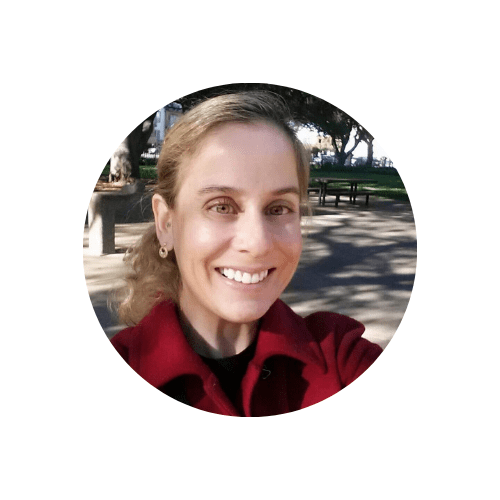
Karen Llagas

Karen Llagas’s first collection of poetry, Archipelago Dust, was published by Meritage Press in 2010. A recipient of a Filamore Tabios, Sr. Memorial Poetry Prize and a Hedgebrook residency, her poems have appeared in various journals and anthologies. She lectures in UC Berkeley and lives in Los Angeles and San Francisco. She is the recipient of the RHINO 2022 Founders’ Prize.

Karen featured in the 2021 National Poetry Month readings co-hosted by Redwood City Public Library.

Poem on Belonging

I GO TO THE OCEAN TO LEARN ABOUT DISTANCE

this morning, at the edge of the Pacific,
crashing to the delight of dogs for whom
waves mean lightness, play.

They jump the way the virus now jumps
across bodies, the morning buses all over
the world near empty. Must I always feel

abandoned? The questions are always
questions of belonging. These days we must
reach for our own answers—I claim

clan with the canine who had cut a swath
on the bed, espresso-colored and ocean-salted,
curled into a bean, seeking warmth from

my nearby body. How far is everyone else
now, or should be. In the California1AX bus,
before distance was something to fret over,

we were near and far at once. I would count
the faces bowed over altars of flickering lights,
the accounting becoming wonder: to look

was the only prayer I could offer. Dear God
I know now I must have belonged to them too.
I am out of words at the beginning of

our new world, having used them up to trick
my fears, so please help us is my morning prayer
thrown to the waves, words of a lapsed Catholic,

a faltering Buddhist, pawing at language,
and doesn’t water always try to answer back?
The ocean calms me like a mother,

let me exhale one more minute: she is a woman
taking the time she needs, letting the ungracious
children scramble among us ourselves.

Copyright © 2021 by Karen Llagas. This poem originally appeared in Migozine January 2021. Used with permission of the author.

Marlo Cowan

“My name is Marlo Cowan. I’m currently a tenth grader, and in my free time I like to read, draw, and play guitar and flute. Poetry inspires me because I consider it to be the most visceral form of writing; you have the ability to contain a story within a few lines and still tell it just as effectively.”

Poem on Belonging

NOT A CLOSET

It’s sixth grade and the world, spinning like a top,
hasn’t landed on its side yet.
August catches like gasoline, burns just as fast. 
Someone wrote FEAR GOD in the girls’ bathroom.
In kindergarten a classmate told me I would go to hell someday. 
Et cetera.
Making soap bubbles in the sink, I stare at the words and think how,
in every painting, Jesus is a long-haired man.

In November the sky is chapped and the graffiti
has been removed from the bathroom. 
I say I don’t remember the decision to cut my hair
but really I don’t remember much at all before I cut my hair,
like watching a movie once and not remembering enough,
years later, to find the title. 
Heard it was about me, don’t know if it was any good. 
We go home for Christmas and all I can think,
with old photos rooted to the mantle, 
dresses hanging in the closet like sheep in a slaughterhouse,
is that I’ve outlasted myself.

January, and the West Coast winter is peeling itself off the walls.
Time gives me a hard look as it passes
and, in endless dialogues with my bedroom ceiling,
I debate how long I could possibly wait.
We live in California no one will care but
swastikas in the bathroom the other day and
how many people do you know who use the word fag so
wait till summer but
tell your friends at least but
maybe they’re too young to understand so
maybe you’re too young to know so
wait until high school or
do it tomorrow or
do it in the car on the way to school or
do it clothes shopping at the mall or
better to wait until summer. 
I don’t know how to say it other than
an object at rest stays at rest. 
And it’s not a closet so much as a bubble, really,
lathered hands of time squeezing either side.
Lathered with soap.
Lathered with summer.
The words stake their footholds and climb up my throat
inch by inch.
January 22nd, and I pop. 

Copyright © 2022 Marlo Cowan. Used with permission of the author.

Rosemary Ybarra-Garcia

Rosemary Ybarra-Garcia is an educator and a lifelong poet who has been a featured poet for several years at coffee shops, bookstores, women’s study classes, and special venues such as “Women and the Muse” in Santa Cruz, CA, 1988; “Floricanto in Xochitle in Cuicatle, Flower and Song” at the De Young Memorial Museum in San Francisco, CA, 1993.

Her poetry has been included in several publications, among those:  Lighthouse Point: An Anthology of Santa Cruz Writers, M PRESS, Santa Cruz, CA; New to North America: Writing by Immigrants, Their Children and Grandchildren, Burning Bush Publications, Santa Cruz, CA; California Quarterly, A California State Poetry Society Publication; Poetry Quarterly, Prolific Press Publication; Calyx Journal, CALYX Press; River Poets Journal, Lily Press; Minute Magazine, Minute Press.  She has published three books of poetry: House of Song, Weaving, and Blue Maze.

Poem on Belonging

LACE AND FAITH

When she moved, she left
laced heirlooms and her faith behind—

the yellowed, crocheted tablecloth, its arms unravelling;
black laced scarves, folded forever in a drawer,

worn by widows at funerals and graveyards,
by a doña who turned the unfaithful to stone

Stern, pale faces stayed behind with tablecloths,
dusty doilies, strict religious hardness

They all stayed behind despite their pleas
for a spot in the moving van

Faith, being so persistent, would find its way,
traveling through miles of countryside,

stopping for water, leaving its stamp,
a bit of itself everywhere

It would cry at the front door until she let it inside
It would not look like the old faith—fat and balding,

wearing a monk’s cassock from the sixteenth century,
wooden rosaries hanging from his waist

No, at first, it would be as unassuming as a kitten, 
mewing its way into her house

Copyright © 2022 by Rosemary Ybarra-Garcia. Used with permission of the author.

Audrey T. Williams

Audrey T. Williams is an Oral Storyteller, Activist, Writer, and Poet based in Oakland, California. She holds an MFA from California College of the Arts and is on the Board of Directors at the Oakland Asian Cultural Center. Her first poetry chapbook, Where I Dream, is available for purchase at Alley Cats Bookstore. She writes, performs, and podcasts creative nonfiction (CNF) in the form of personal narratives, and is also working on short stories of Speculative Fiction and AfroFuturism. Audrey featured in Peninsula Virtual Bookfest co-hosted by the Daly City Public Library.

Heather Bourbeau

As a communications strategist and researcher with expertise in climate change, conflict, migration, humanitarian aid, and technology, Heather Bourbeau has worked with colleagues around the world to produce influential high-level reports and communications strategies.

She has developed strategic political analysis and reports for high-level UN officials and overseen multinational teams in complex and sensitive political environments. She has transferred her research and functional skills into effective and compelling design research and communications strategy projects with various UN agencies, as well as hardware start-ups and established technology companies. 

Heather Bourbeau’s work has appeared in 100 Word Story, Alaska Quarterly ReviewThe Kenyon ReviewMeridianThe Stockholm Review of Literature, and SWWIM. She is the winner of La Piccioletta Barca’s inaugural competition and the Chapman Magazine Flash Fiction winner, and has twice been nominated for a Pushcart Prize. Her work has been featured in several anthologies, including Nothing Short Of 100: Selected Tales from 100 Word Story (Outpost 19), America, We Call Your Name: Poems of Resistance and Resilience (Sixteen Rivers Press), and Respect: Poems About Detroit Music (Michigan State University Press). 

Poems

SHELTERING

I paused along the path, caught the echo of skunk, its distinct musk that, in the brief instant before my brain recalled the source, was pleasing in the same way my own body odor at first warmed then revolted me.

I felt relief as I peed behind a bush, wind gusting all around. I took in a deep breath to smell the sage, then focused on the rivulet that ran over rocks and dirt, broken remnants that will outlive me.

In the time before, I stood in front of Monet’s hints of wisteria, emerging from a world of blurred purple and green. Through the pain of nearby bombs, failing eyes, and his beloved’s passing, he heard the call to water, to focus on the blooms.

I have worked grooves into the ground around my house, cursed and mourned the weeds that I pull. I have waited for a young stag to stop eating the oxalis so that I could enter my gate.

I wake forgetting for just a moment, delicious drowse. Then, like Claude, I seek respite and touchstones, answers inadequate to a why shared and solitary, beyond the will of man.

STOW AWAY

Thick fog, light rain. Days like this, my hair betrays my roots.
Curls twist, gain momentum, desperate to drink every drop.

I rush to plant ground cover, to profit from the damp.
But the ants, they swarm in upturned earth, frantic for cover.

One climbs into my sweater, waits for my tea to steep, my legs to fold
under thick blankets before attempting an escape, tickling my arm.

I appreciate the effort, the careful plotting or headlong launch that led
to my unwitting transport, but I have laid bay laurel and cinnamon

at my threshold, tightened all my caps, stowed honey on high shelves.
There is only so much outside I will let in. The dirt under my nails.
The echoes of fog in my hair.

RICHTER’S SCALE 

Rains have brought mushrooms, softened a thirsty ground,
mulched and heavy with greying leaves.
My neighbor’s morning glory wraps round their trellis,

chokes trees that scratch my home, make roads for squirrels.
The earth shook last night, and I slept soundly soon after.
Should I worry—this messy line between accustomed and detached?

In my yard lie the remnants of my landlord’s neglect—fallen
bits of roof, broken path lights, balls from games played by children
grown and gone, a green toy soldier kneeling, rifle aimed.

Nasturtiums never planted sprout and spill, twisting
up my steps, covering what the oxalis cannot.
The sun has come too soon. I feel my throat prepare to parch.

Copyright © 2022 by Heather Bourbeau. These poems originally appeared in MiGoZine Summer 2021.

Janice Lobo Sapigao

Janice Lobo Sapigao (she/her) is a daughter of immigrants from the Philippines. She is the author of two books of poetry: microchips for millions (Philippine American Writers and Artists, Inc., 2016) and like a solid to a shadow (Timeless, Infinite Light, 2017 by way of Nightboat Books). She was named one of the San Francisco Bay Area’s Women to Watch in 2017 by KQED Arts. She is a VONA/Voices and Kundiman Poetry Fellow. She earned a Master of Fine Arts degree in Writing from California Institute of the Arts (CalArts) and a Bachelor of Arts degree in Ethnic Studies with Honors and a minor in Urban Studies & Planning from the University of California, San Diego. She is currently an Associate Professor of English at Skyline College in San Bruno, CA, 2020-2021 Santa Clara County Poet Laureate Emeritus, and was a Poet Laureate Fellow with the Academy of American Poets.

Janice featured in the Peninsula Virtual Bookfest co-hosted by the Daly City Public Library.

McTate Stroman II

McTate is a spoken-word artist, guest lecturer and motivational speaker. Over the past 25 years he has had the opportunity to share his inspirational talents at such places as; The World Stage in Leimert Park, The Comedy Store on Sunset, Nuyorican Poets Cafe in New York, UCLA,  USC, and San Jose State University. 

With a degree in Psychology from San Jose State University, McTate, is an educator and artist whos’ art tends to focus on our emotional intelligence. As an educator he counsels students and parents on the budgetary cost of education, as he interprets and explain Federal, State and district regulations, requirements, policies and procedures.  

McTate is the host and founder of the long running First Thursday’s Open Mic, held at the beautiful Euphrat Museum on De Anza College’s campus. As an artist, McTate shares his thoughts and feelings in hopes of being an exemplary source of inspiration.

James J. Siegel

James J. Siegel is a San Francisco-based poet and literary arts organizer. He is the host and curator of the popular monthly Literary Speakeasy show at Martuni’s piano bar. Originally from Toledo, Ohio, his first poetry collection, How Ghosts Travel, was inspired and fueled by his coming of age in the Midwest and was a finalist for an Ohioana Book Award. He was a scholarship recipient to the Antioch Writers’ Workshop in Yellow Springs, Ohio, and his poems have been featured in a number of journals including The Cortland ReviewBorderlands: Texas Poetry ReviewAssaracusThe Fourth RiverHIV Here & NowThe Good Men Project, and more. He was also featured in the anthology Divining Divas: 100 Gay Men On Their Muses.

Poems

THE SAN FRANCISCO POLICE RADIO SINGS DANNY BOY

This is all you will need to understand
the death of another unarmed man by
the San Francisco Police Department –
Danny Boy, the pipes, the pipes are calling
crackling over the police radio
when Dan White murdered Milk and Moscone.
Four shots and the mayor is dead, five more
and the mayor of Castro Street is gone.
That bright November day turned to darkness –
Summer’s gone and all the roses falling
and down at the hall of justice a cheer,
a tip of the hat and hip hip hooray
for the golden boy of the police force,
good old boy of the old San Francisco
when men were men and the city was theirs.
Screams echoed off the walls of city hall
while squad cars sang a different melody –
and I am dead, as dead I may well be
O Danny Boy, you finally did it,
pulled the trigger we always wanted to pull.
And so it goes – all this blood on the badge
soaked deep into the blue, a lineage
of the protectors protecting their own.
All this is nothing new to a city
where Danny crawled through an open window –
a holstered .38 Smith & Wesson –
and did what the cops were only thinking,
did what the cops today are still thinking.
That revolver is always reloaded
and those cherry red lights are still chasing
life after life into another grave.
Listen to those sirens harmonizing,
lean in close and listen to the chorus
of bullets as they whisper to the air
and you may hear a soft ballad beneath
that sings: O Danny Boy, I love you so.

GOLD RECORD
“The spacecraft will be encountered and the record played only if there are advanced spacefaring civilizations in interstellar space.”
—Carl Sagan

Dark was the Night, Cold was the Ground –
what will intelligent life say when
the stylus drops on the gold record
and that bottleneck guitar echoes through

the halls of space, moans like salvation,
a southern church in the dark of December,
Willie Johnson’s penknife gliding down the frets,
fingers plucking out a crucifixion hymn?

Does any such sound exist beyond
the solar winds, past the heliopause?
Can life outside this galaxy comprehend
a black man’s hands divining a passion play?

Perhaps there is a civilization
that can translate the record’s 55 languages,
the Aramaic for “peace,” the Latin words
“Greetings to you, whoever you are.”

A billion miles from this world
another world may recognize
the rhythm of rain and thunder,
the timbre of wind and wild dogs,

the percussion of the human heart.
But does it recognize the frequency
of a man’s soul vibrating off strings,
the Christ in a chord change?

This Earth has always been
an earth of suffering, Garden of Gethsemane
where disciples busk on street corners,
preaching the gospel of gospel blues.

On this earth a man’s song is more valuable
than the man. A sharecropper’s son
reshaping his suffering into musical notes,
music into prayer. Transubstantiation
traveling from instrument to airwaves
to the lost and forsaken adjusting their radio dials,
a promise of deliverance reaching the vast spaces
of America.

And still this world allowed him to die
alone in a home with no roof –
only the dying light of the stars above –
buried in a forgotten Texas cemetery.

Now those same stars draw him in
to the edges of an unexplored universe.
Will it understand what to do
with this human harmony turned holy?

Perhaps it has always been waiting
for that open D tuning, the key change
that unlocks the heavy doors of creation,
shines a light upon the face of the deep.

Listen to the suffering of one lonely world
released as a deep-throated melody
that propels the dust of the cosmos to collide,
perfects a new planet spinning in the heavens.

Copyright © 2022 by James J. Siegell. These poems originally appeared in MiGoZine Summer 2021. Used with permission of the author.
Francesca Bell

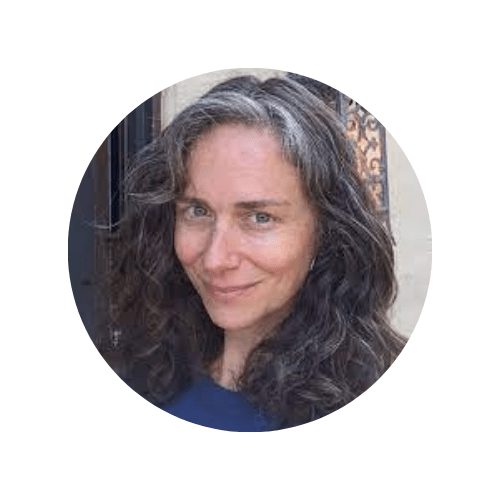
Francesca Bell was born in Spokane, Washington into a family with deep, hardscrabble roots in the Northwest. Her maternal great-grandfather, the son of a prostitute and her client, was raised in a brothel. He raised his own six children, including Bell’s grandmother, on a 160-acre homestead in Plummer, Idaho. On her father’s side, the Norwegian Wikum family, when traced 700 years back, was already renowned for its spectacularly heavy drinking. The hard living continued in America where the clan was referred to around Coeur d’ Alene, Idaho as “the fighting Wikums.”

Bell was raised in Washington and Idaho and settled as an adult in California. She did not complete middle school, high school, or college and holds no degrees. She has worked as a massage therapist, a cleaning lady, a daycare worker, a nanny, a barista, and a server in the kitchen of a retirement home.

Bell’s writing appears in many magazines including ELLE, Los Angeles Review of Books, New Ohio Review, North American Review, Prairie Schooner, and Rattle. Her translations appear in Arc, Circumference, Mid-American Review, The Massachusetts Review, River Styx, and Waxwing. Her first book, Bright Stain (Red Hen Press, 2019), was a finalist for the Washington State Book Award and the Julie Suk Award. In 2023, Red Hen Press will publish her second book of poetry, What Small Sound, and a collection of poems by Max Sessner that she has translated from German. She is translation editor at the Los Angeles Review.

Also to her credit are three luminous and eccentric children, a half-trained beagle, and some very nice blackberry jam.

Francesca featured in the Peninsula Virtual Bookfest co-hosted by the San Mateo County Libraries (4:08).

Kimi Sugioka

Kimi Sugioka is an educator and poet. She earned an MFA at Naropa University and has published two books of poetry; the newest of which is Wile & Wing on Manic D Press. As the Poet Laureate of Alameda, she engages the community in a multi-cultural and intergenerational exploration of poetry and literature. Her work appears in anthologies such as Civil Liberties United, Endangered Species, Enduring Values, Standing Strong, Colossus, and Colossus: Home.